
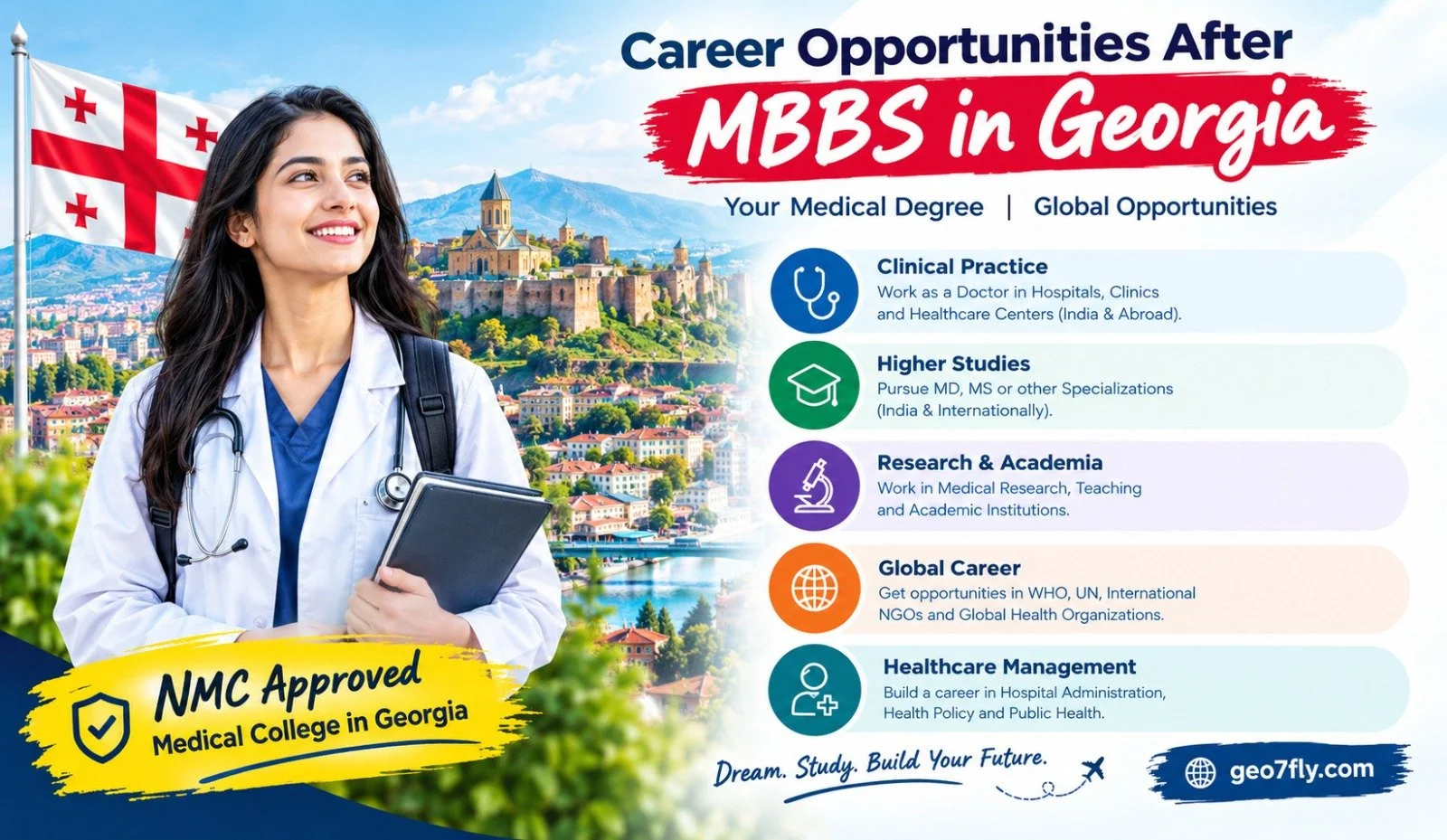
Career Opportunities After MBBS in Georgia: Complete Global Roadmap

Introduction: Why Planning Your Career After MBBS in Georgia Matters
Choosing to pursue an MD/MBBS degree abroad is one of the most critical decisions an aspiring medical student can make. Georgia has emerged as a powerhouse destination for global medical education due to its WHO and NMC-recognized universities, European curriculum standard, and affordable tuition structures. However, getting your degree is only the first step. The true value of your degree lies in understanding the scope of your career after MBBS in Georgia.
Graduating from a Georgian medical university opens a world of opportunity. Because Georgian universities align with European Higher Education Standards (ECTS) and follow WFME (World Federation for Medical Education) guidelines, international graduates hold degrees that are recognized across India, the United States, the United Kingdom, Europe, Canada, and the Gulf region. Whether your goal is to practice medicine in India, pursue clinical residency in the US, clear PLAB for the UK, or transition into non-clinical sectors like hospital management and medical research, your career after MBBS in Georgia can lead to diverse and lucrative avenues.
This ultimate guide breaks down every single clinical and non-clinical career pathway, licensing exams, post-graduation opportunities, salary expectations, and practical steps to build a high-impact global medical career.
Global Recognition: The Foundation of a Successful Career After MBBS in Georgia
Before exploring specific career pathways, it is essential to understand why a degree from Georgia is respected worldwide. The strength of your career after MBBS in Georgia relies on the university's accreditation status.
Accreditation Framework & International Authorities
Georgian medical universities are evaluated, accredited, and listed by major international medical bodies:
World Health Organization (WHO): Listed in the World Directory of Medical Schools (WDOMS).
National Medical Commission (NMC - India): Compliant with the Foreign Medical Graduate Licentiate (FMGL) Regulations 2021 (6-year duration including internship, English medium, clinical rotations).
Educational Commission for Foreign Medical Graduates (ECFMG - USA): Qualified to apply for USMLE Step 1 and Step 2 CK.
General Medical Council (GMC - UK): Eligible to sit for PLAB/UKMLA examinations.
Foundation for Advancement of International Medical Education and Research (FAIMER).
Due to these universal accreditations, a graduate’s career after MBBS in Georgia is not restricted to a single country.
1. Practicing in India: Clearing NExT / FMGE
For Indian students, the primary path in their career after MBBS in Georgia is returning to India to practice as a registered medical practitioner.
Understanding the NExT Examination
The National Exit Test (NExT) replaces the traditional FMGE (Foreign Medical Graduate Examination) and NEET-PG. NExT serves a dual purpose:
Licensing Exam: Qualifying NExT Step 1 is mandatory to register as a practitioner in India.
Post-Graduate Entrance: NExT scores determine admission into MD/MS/DNB postgraduate seats across Indian medical colleges.

Strategy for Clearing NExT / FMGE
Early Preparation: Focus on basic medical sciences (Anatomy, Physiology, Pathology, Pharmacology) during years 1–3 in Georgia.
Clinical Integration: Ensure strong participation during clinical clerkships in Georgian university-affiliated hospitals.
Resource Alignment: Utilize standardized prep tools (Standard textbooks along with question banks tailored for NExT/FMGE).
Detailed guidance on course structures can be explored through the official Study MBBS in Georgia portal.
2. Practicing in the United States: The USMLE Pathway
If your ultimate goal for a career after MBBS in Georgia is practicing in the United States, the USMLE (United States Medical Licensing Examination) is your direct pathway.
Step-by-Step USMLE Journey
ECFMG Eligibility: Georgia's top medical universities are ECFMG certified, allowing students to apply for USMLE during their medical studies.
USMLE Step 1: A pass/fail exam focusing on foundational scientific concepts. Students are advised to attempt Step 1 during their 4th or 5th year of medical school in Georgia.
USMLE Step 2 CK (Clinical Knowledge): A score-based exam measuring clinical understanding. High scores on Step 2 CK are critical for securing residency matches.
US Clinical Experience (USCE): Completing 2–3 months of electives, observerships, or externships in US hospitals to secure Letters of Recommendation (LORs).
The MATCH (NRMP): Applying to US residency programs through ERAS (Electronic Residency Application Service).
USMLE Step 3 & Residency Training: Completed during the first or second year of US residency training.
Average US Resident Salary
PGR-1 (Year 1 Resident): $65,000 – $75,000 / year
Practicing Physician Post-Residency: $220,000 – $400,000+ / year (depending on specialization).
3. Practicing in the United Kingdom: The PLAB / UKMLA Pathway
The United Kingdom offers an attractive environment for building a stable career after MBBS in Georgia. The National Health Service (NHS) relies heavily on internationally trained doctors.
Navigating PLAB / UKMLA
PLAB 1 (Professional and Linguistic Assessments Board): A written exam consisting of 180 single best answer questions. Can be taken in multiple test centers worldwide, including India and Georgia.
PLAB 2: An OSCE (Objective Structured Clinical Examination) conducted exclusively in Manchester, UK.
Transition to UKMLA: The UK is transitioning to the UKMLA (United Kingdom Medical Licensing Assessment), bringing a standardized format for both international and domestic graduates.
GMC Registration: Upon passing PLAB 1 & 2 (or UKMLA) and proving English language proficiency (IELTS/OET), graduates receive full GMC registration to apply for FY2 (Foundation Year 2) or Specialty Training (ST1) positions.
4. Practicing in Georgia & the European Union (EU)
For students who wish to stay in Europe, a career after MBBS in Georgia provides direct access to European medical systems.
Medical Career Inside Georgia
State Medical Examination: International graduates who pass the Georgian State Medical Licensing Exam can practice as general practitioners or medical officers in Georgian private and public hospitals.
Residency in Georgia: Georgia offers residency programs in internal medicine, surgery, pediatrics, and emergency care conducted in English and Georgian.
Transitioning to EU Nations (Germany, Austria, Switzerland)
Because Georgia is an official EU candidate nation and aligns its higher education with the Bologna Process, moving to mainland Europe is a viable path:
Germany (FSP & KP Pathway): Doctors must attain B2/C1 level fluency in German, pass the Fachsprachenprüfung (Medical German Language Test), and complete the Kenntnisprüfung (Equivalency Assessment) to receive the Approbation (medical license). Germany offers tuition-free medical residency with competitive salaries.
5. Medical Practice in the Gulf Countries (GCC Region)
The Middle East (UAE, Saudi Arabia, Qatar, Oman, Kuwait) represents a lucrative alternative for expanding your career after MBBS in Georgia.
Licensing Requirements for GCC Nations
Dubai / UAE (DHA / MOH / DOH Exam): Requires an MBBS degree, completion of a 12-month internship, and typically 1–2 years of clinical experience post-internship.
Saudi Arabia (SMLE): Medical graduates can sit for the Saudi Medical Licensing Examination.
Qatar (QCHP): Clearing the Prometric exam enables clinical practice in Qatar's modern healthcare facilities.
Benefits of Working in the Gulf Region
Tax-free competitive salaries ($5,000 – $12,000/month for Junior Doctors).
Proximity to Asian home countries.
State-of-the-art medical infrastructure and international working environment.
6. Non-Clinical & Alternate Career Pathways After MBBS
Not every medical graduate wishes to pursue direct patient care. A degree from Georgia equips you with analytical, scientific, and management skills suitable for high-paying non-clinical sectors.
A. Master of Public Health (MPH)
Pursuing an MPH in countries like Canada, Australia, the US, or the UK allows graduates to work with global entities like WHO, UNICEF, or national health agencies as epidemiologists, health policy advisors, and public health directors.
B. Hospital & Healthcare Management (MBA in Healthcare)
Medical graduates with business acumen can manage hospital operations, quality assurance, and healthcare logistics. Positions include Hospital Administrator, Medical Director, and Healthcare Consultant.
C. Clinical Research & Pharmacovigilance
The pharmaceutical industry actively recruits MBBS graduates as Clinical Research Associates (CRA), Medical Advisors, and Pharmacovigilance Officers to monitor drug safety and oversee clinical trials.
D. Medical Writing & Health Communications
Doctors with strong written communication skills can create medical journals, clinical documentation, regulatory filings, and patient education content for healthtech firms and publishers.
E. Health Technology & Artificial Intelligence
With the rise of HealthTech, medical graduates work alongside software engineers to design AI diagnostic tools, telemedicine platforms, and electronic health record (EHR) systems.
Clinical vs Non-Clinical Pathways: Comparison Matrix
| Pathway / Destination | Key Licensing Exam / Requirement | Avg. Starting Salary (Annual USD) | Key Advantage |
|---|---|---|---|
| India | NExT / FMGE | $10,000 – $18,000 | Home country practice, massive clinical exposure |
| United States | USMLE Step 1, Step 2 CK, Step 3 | $65,000 – $75,000 (Residency) | World-highest doctor salaries & advanced tech |
| United Kingdom | PLAB 1 & 2 / UKMLA + OET | $45,000 – $60,000 (FY2/ST1) | Structured training, NHS benefits |
| Germany / EU | German C1 + FSP + Kenntnisprüfung | $55,000 – $70,000 (Resident) | Tuition-free residency, European residency visa |
| GCC / Gulf Countries | DHA / MOH / Prometric | $40,000 – $80,000 (Tax Free) | High tax-free income, close proximity to Asia |
| Non-Clinical (MPH/MBA) | GRE / GMAT / IELTS (as per university) | $50,000 – $90,000 | No night shifts, corporate career progression |
How Geo7Fly Accelerates Your Career After MBBS in Georgia
Building a successful career after MBBS in Georgia starts on day one of your university admission. Geo7Fly provides end-to-end guidance to ensure students don't just secure admissions, but also build a structured plan for post-graduation success.
Geo7Fly Support Ecosystem:
Accredited University Selection: Guiding students toward WHO, ECFMG, and NMC-compliant universities in Georgia.
Licensing Exam Orientation: Early counseling and resource access for USMLE, NExT, and PLAB readiness.
Documentation & Visa Services: Seamless assistance for student visas, ECTS transfer processing, and post-graduation documentation legalization.
Career Mentorship: Connecting students with alumni practicing in the UK, US, India, and Georgia.
Explore full details on student support through our Student Assistance Services page or read real student journeys on our Student Testimonials section.
❓ Frequently Asked Questions (FAQs)
Q1: Is an MBBS degree from Georgia valid in India for practicing medicine?
Yes, an MBBS (MD) degree from recognized Georgian universities is fully valid in India provided the university complies with NMC Foreign Medical Graduate Licentiate (FMGL) regulations 2021. Students must clear the NExT / FMGE exam to register with the State Medical Council.
Q2: What is the main licensing exam required for a career after MBBS in Georgia when returning to India?
Graduates must clear the National Exit Test (NExT), which replaces the FMGE and serves as both a licensing exam and an entrance test for postgraduate medical seats in India.
Q3: Can I apply for USMLE while studying MBBS in Georgia?
Yes, most top medical universities in Georgia are listed in WDOMS and recognized by ECFMG, allowing students to take USMLE Step 1 and Step 2 CK during or after their medical degree.
Q4: Is internship in Georgia accepted by the NMC in India?
NMC FMGL guidelines mandate a 54-month course plus a 12-month internship completed in the same foreign institution, followed by a 12-month internship in India after clearing NExT Step 1.
Q5: What is the career scope after MBBS in Georgia for practicing in the UK?
Graduates can sit for the PLAB (or UKMLA) exams along with proving English proficiency via IELTS or OET to gain GMC registration and work in NHS hospitals across the UK.
Q6: Can foreign graduates practice medicine directly in Georgia after graduation?
Yes, foreign students who pass the Georgian State Medical Examination can register and practice as medical practitioners or join local residency programs in Georgia.
Q7: How long is the MBBS program in Georgia including internship?
The MD (MBBS equivalent) program in Georgia lasts 6 years, which includes integrated practical clinical rotations and clerkships fulfilling NMC standards.
Q8: What are the non-clinical career options for a career after MBBS in Georgia?
Non-clinical careers include Master of Public Health (MPH), Health Care Management (MBA), Pharmacovigilance, Clinical Research, Medical Writing, and Health Technology consulting.
Q9: Is learning the Georgian language necessary for building a clinical career in Georgia?
While the academic medium of instruction is 100% English, learning basic Georgian is essential during clinical rotations to interact smoothly with local patients in hospitals.
Q10: What salary can I expect in a career after MBBS in Georgia if I clear USMLE and match in the US?
US medical residents earn between $65,000 and $75,000 annually during training. Fully licensed attending physicians earn between $220,000 and $400,000+ per year.
Q11: Can I do PG in Germany after completing MBBS in Georgia?
Yes. You must learn German up to C1 level, pass the Medical German Language Exam (FSP), and clear the equivalency exam (Kenntnisprüfung) to secure paid residency positions in Germany.
Q12: How does Geo7Fly help students plan their career after MBBS in Georgia?
Geo7Fly provides complete counseling, selection of ECFMG/NMC approved universities, licensing exam prep guidance, and post-degree career transition support.
Q13: Are Georgian medical degrees recognized across Europe?
Yes, Georgia aligns its education with the European Higher Education Area (EHEA) and Bologna Process, making its ECTS credits widely recognized across Europe.
Q14: What is the eligibility for practicing medicine in GCC/Gulf countries after MBBS in Georgia?
Graduates need their accredited MBBS degree, completion of internship, passing marks on regional licensing tests (DHA/MOH/SMLE/Prometric), and typically 1–2 years of clinical practice experience.
Q15: What is NExT Step 1 and NExT Step 2?
NExT Step 1 is a computer-based theoretical test assessing clinical concepts. NExT Step 2 is a practical exam evaluating clinical skill competence after the internship.
Q16: Is PLAB difficult for students graduating from Georgia?
Since Georgian universities follow an advanced European curriculum, students with strong clinical foundations find PLAB preparation manageable with structured revision.
Q17: Can I pursue clinical research as a career after MBBS in Georgia?
Yes. Medical graduates can join pharmaceutical companies, CROs (Contract Research Organizations), and bio-tech firms as Clinical Research Associates or Medical Monitors.
Q18: Are scholarships available for postgraduate studies after MBBS in Georgia?
Many universities in the US, UK, and Europe offer merit-based scholarships and research stipends for Master's and PhD programs in Public Health, Neuroscience, and Biomedicine.
Q19: What medium of instruction is used in Georgian medical universities?
All major medical programs for international students in Georgia are conducted completely in the English language.
Q20: What is the difference between MD and MBBS in Georgia?
In Georgia and Europe, the primary medical degree is awarded as MD (Doctor of Medicine), which is legally equivalent to the MBBS degree awarded in India and UK systems.
Q21: Can I switch to Dentistry or Allied fields if I choose not to continue clinical MBBS practice?
Yes, students interested in broader healthcare avenues can look into alternative programs or complementary pathways like Dental Programs in Europe or Nursing Education Pathways.
Q22: How can prospective students get personalized career counseling for MBBS in Georgia?
Students can connect directly with experienced education advisors by visiting the Contact Medical Counselor page or calling +91 881 881 0711.
Take the Next Step with Geo7Fly
Ready to plan your global medical journey and secure admission into top-ranked Georgian universities? Contact the team at Geo7Fly today for expert step-by-step guidance!
📞 For Registrations: +91 881 881 0711
🌐 Website: www.geo7fly.com
📥 Free Medical Counseling: Contact Geo7Fly Experts

